Showing posts with label Newman. Show all posts

Wednesday, December 24, 2014

Unknown English Accents

We all know the classical American or British accents. Some are even familiar with a Scottish one or an Australian one. However, these are not the only possible English accents out there, so I decided to put together a little list of the lesser known accents that deserve to be talked about more.

1. Singapore/Malasya
Singaporeans speak really fast, really fast. Sometimes they also cut certain word like ‘the’ or ‘a’. They often end their sentences with ‘la’, for no particular reason. Some words are simplified like the word ‘want’ becomes ‘one’, the word ‘three’ becomes ‘tree’ and ‘or not’ becomes ‘anot’.

2. South African
The ‘i’ is pronounced more like an ‘oi’ in oil, but flatter. They also roll their ‘r’, almost the way the French pronounce it, except they don’t hold it for quite so long. The consonants are also pronounce very harshly, like they were just spat out. The ‘a’ like in ‘man’ is also pronounced more like ‘e’, as if you had it in plural.

3. Geordie
This accent comes from a region in the North East England. They pronounce the ‘e’ like in ‘eight’ more like ‘ijght’, almost as if there were two sounds. The ‘o’ in words like ‘town’ becomes more like the word ‘u’ in ‘dug’.  The –er at the end of the word becomes wider. The ‘t’ in words like ‘water’ is replaced with a glottal stop, as if you’d get a hiccup mid-word.

4. Honk Kong
If you try to do a Hong Kong accent you have to say your sentence in a very flat, monotonous way before going down right on the end of the sentence. There is also no difference between the ‘f’ and the ‘th’ sound, or the ‘l’ and the ‘r’. The ‘r’ is also prolonged. You can also finish your sentence by adding ‘ah’ or ‘won’.


Why do we hate our voice?

The biggest problem with trying to correct your accent is that you are supposed to record yourself and listen to yourself talk.  That is the most demoralizing thing you can eve experience.  Not because you usually talk slightly worse than you think, but because you have to listen to yourself, specifically your voice. Many, if not most people hate the sound of their voice when it’s played back to them. They say it’s usually higher pitched, just rougher all together.


Why do we hate it?


That is because when you talk, you hear your voice in a number of ways. Of course, you still hear it with your ears like any other person, but you also hear it with your bones. The bones also transfer the waves to your brain, making your voice sound deeper and smoother than it really is.

What can we do about it?

Well, you can’t really change your voice, but you can learn how to use it better. If you record yourself often enough, you’ll eventually be able to pin-point specific things that bother you and you can work on changing that. Some yourtubers say that they basically change the way they speak over the years, specifically because they had to listen to themselves so many times.

I think it’s also very helpful to take a rhetoric or acting class. Starting off alone can be difficult and they will probably inform you of the things you have to pay attention to. It’s also less soul-crushing than hearing your terrible, terrible voice being played back to you over and over.


If that’s out of your budget or you simply don’t have time, youtube videos are also helpful. My personal favorite is Videojug’s Gareth Jameson. His videos are a good starting point, specifically if you want to do an accent.


Tuesday, December 23, 2014

English on Words!

This year at my university we have been ask to reflect on how we learn English, specifically how we add words to our vocabulary. Most of the time this includes making lists that you have to repeat several times, which can get a little tedious or grating over time. When that happens, you can lose track of why you became so passionate about the language in the first place and you need to renew it. 
For me, the best way is to go and look for completely obscure parts of the language, those special tiny places that most people don’t notice and are not even particularly relevant to anything you might be currently doing, but are just interesting and funny.
So I decided to celebrate the passion for words by listing my top 10 obscure words of the English language, the definition, and a little bit of what I think of them. So here it goes:
1. Defenestration (def.: the act of throwing someone or something out of a window)
Want to sound threatening yet sophisticated? This is the word for you! Just the fact that this words exist says something about our society. I’m not sure what, but it certainly does!  Nevertheless, this is still a great word to know. Not because you could use it every day, but because when something like that does happen, you’ll know exactly how to describe it. The only sad thing about this is that it’s doesn’t appear in political reports often enough.
2. Pulchritudinous (def.: used of persons only; having great physical beauty)
What demon from hell thought this was a good idea? Telling someone they’re pretty hard enough without having to twist your tongue in a butterfly knot. If you really want to convince someone you’re good at French kissing there are surely more practical ways to do it so they won’t wonder if they have a serious medical condition.
3. Lackadaisical (def.: idle or indolent especially in a dreamy way)
I haven’t learned this word soon enough! This should be in the active vocabulary of any chronic daydreamer. It’s the perfect word to use as a retort when someone accuses you of not paying enough attention. It’s correct, yet it also makes you sound smart enough not to be labeled as lazy. It’s a win-win situation… but your mom will still want you to do the dishes.
4. Arachibutyrophobia (def.: the fear of peanut butter sticking to the roof of one's mouth )
I’m sure that this is a serious issue for some people, but that doesn’t make it any more obscure. It’s just such an oddly specific fear to have. Still, I also think that it must be one of the easiest fears to avoid, given you’re not a peanut butter addict.
5. Hippopotomonstrosesquipedaliophobia (def.: the fear of long words)
Also great evidence that the people devising the English language are all secretly sadists (as if the spelling didn’t give it away). Well, to be fair it derives mostly from Latin, but you’d think that the language that turned ‘ananas’ into ‘pineapple’ wouldn’t have issue with taking artistic liberties every once in a while. How do people with this phobia even name their condition? Part of me imagines them going to a therapist and saying: “I have… I have… I have that which must not be named…”
6. O-O (def.: a honeyeater (bird) found in Hawaii, now probably extinct, which had a thin curved bill and climbed about on tree trunks.)
This probably has roots in the old Hawaiian language, but that doesn’t mean that I won’t crack jokes at it. Did God get drunk one night, made this bird and then went ‘oh-oh’? Were the people that first saw this bird so awe-struck that they could only name it after the face they made (O-O)? Did they name it that because someone who killed the last one just went ‘oh-oh’? Too soon?
7. Pre-loved (def.: second-hand)
I’m not including this word because it would be so obscure, but just because it’s so… perfect. What an incredibly adorable way to say your dress or your teddy bear were owned by other people before you. Still, I wouldn’t really use it when it comes to other things like kitchen appliances. “So you got a new dishwasher?” “No, it’s pre-loved.”
8. Petcock (def.: a small valve positioned in the pipe of a steam boiler or cylinder of a steam engine for drainage or testing)
Nope, this word doesn’t describe a pet rooster or a very specific kink. It’s also one of the words that illustrate the need for interlingual translators the most.  Would you trust a 18-year-old intern to properly translate this?
9. Callipygian (def.: having well-shaped buttocks)
Now, here’s a word that is not what the language deserves, but what it needs! Commenting on someone’s back-side has never sounded more intellectual.  Granted, most people probably won’t understand what you mean, but that makes it even better. Let’s face it; who doesn’t appreciate a nice set of buns? It really does deserve a word of its own.
10. Criticaster (def.: a minor or inferior critic)
I guess today this would be known as a ‘hater’, but this word is evidence that they probably existed way back in the 17th century. 

Tuesday, December 2, 2014

Vocab Learning Strategies

My preferred method of learning vocabulary is doing the exercises on Vocabulary.com, primarily the Porter lists. I also use thesaurus.com and sticky notes, but I generally avoid corpora. I would like to use more dictionary apps, but most require internet access which I don’t have all the time.

I like using Vocabulary. com for several reasons. Firstly, I like being able to store the words I want to learn and sort them the way I prefer, be it alphabetically or according to my learning progress. Secondly, the generated vocabulary quizzes I can make myself are by far the most entertaining and satisfactory way to learn vocabulary. They test you on different meanings of the word, set it in different contexts, make you find their antonyms or synonyms and, of course, check your spelling of it. Even if studying online does get a little tedious at times, the site tries to keep you interested and motivated through achievements, classes and leader boards. If you’ve answered correctly five times in a row, you get an achievement. You mastered a word, also achievement. You managed to rake up an impressive amount of points- you get a higher class.

Along with Vocabulary.com, I also find thesaurus.com to be extremely useful. It is a site where you can search for synonyms. It’s very easy to use and the result filters are extremely useful. You can sort them by length or complexity, making academic words easy to spot. Nevertheless, I usually double check this on Vocabulary.

Sometimes I also use a more old-fashioned approach; sticky notes. I write down the word I want to learn on a sticky note and stick it somewhere I can see it every day. This method is mostly reserved for words that are really hard to memorize or are impossible to spell.


I generally don’t use corpora. I don’t know exactly why, but somehow I just find them annoying to use. You usually already have to know a word in order to look it up. However, unlike the dictionary, the corpus does not provide a clear definition. It does show words in different contexts, but these results are usually not sorted by word meanings. Since most learners’ dictionaries provide at least one or two examples for every meaning anyway, it’s not like you’re left completely in the dark.


Saturday, June 21, 2014

Game Hype: the Forest

I recently saw some youtube Let’s plays for a new game called The forest and I thought it was amazing. It’s supposed to be survival horror with a capital ‘SURVIVAL’. You not only have to worry about your health, but you also have to pay attention to your hunger, your energy and your temperature.

I thought it was really neat, since you actually go around the forest, chop down trees, collect food… You can actually build quite a nice house or fort. I thought it was nice that the game also included a little bit of creative possibilities. Of course, being practical is in the forefront.

The building itself is pretty realistic too. You have to chop down trees and once you place the logs, sticks, or stones, you actually see them fill out one part of the blueprint you set up. It also has reasonable requirements. You see an item has tree logs? You have to get tree logs. The cabin needs 28? Well, I guess you’ll have to settle for a long term process on that one.

As I mention before, the game is also horror, so you are constantly being hunted by cannibals around the area. That is an aspect I don’t think works that well. I sort of feel most players enjoy the building and exploration more than the combat. This might come from the fact that everyone says the find the combat to be poorly designed, like a player must hit the cannibal 10 times to kill them, but one direct hit from them and you are dead. You could rebuke this by saying that it’s a horror game and you are meant to be scared and afraid of fighting these monsters like it was the case with the Silent Hill series. But in most other horror games you don’t have to actually survive, just make sure your health bar doesn’t drop too low. Here I think the horror or panic could come from the basic attempts to keeping your character alive. I’m not saying they should take the fighting out of it, I’m just saying that maybe they could make the swarms that come after you smaller, or lower the amount of hits needed to kill a guy.


As of now, the game still has a LOT of bugs, since it’s an early- access one, but I really think it has a lot of potential. Check it out!

Friday, June 20, 2014

Culture Days topics

 This Monday we had Culture days at our university, so I apologize if this blog post makes no sense to the outside reader.

 So I attended 12 presentations. I ran out of feedback sheets for two of them.
For the Irish part I visited Polar Opposites - Northern Ireland and Basque Conflict and Irish Intelligence at its peak. I wanted to see the presentation on Irish women, but unpredictable circumstances got in between. I was disappointed no one seemed to have been talking about the Celts.

For American culture I went to Same-sex marriage, American Indian boarding schools, The Boston Tea Party (sadly did not include actual tea, nor a party),  Ernest Hemingway, American gun culture, Massacre at Virginia Tech,  Flappers, The Smurfs are real, Religion in the US education system and, my personal favorite, American political satire.

The ones that I would like to talk about the most on the day of my KGP are:
-          -Same-sex Marriage: Because I remember it being a very hot topic while I was in high school so I have devoted a lot of thought to this topic.
-          -The Flappers: I liked learning about them as I always admire women who go against old society norms.
-          -Religion in the US education system: I see a lot of talk about it on the Internet or the American news shows, especially when it comes to Sex-ed.
-          -American gun culture: because… ‘MURICA!!! Also because there seems to be a lot going on with the new open-carry protests in Texas.  
-         - American political satire: Because I was a devoted watcher of The Daily show and the Colbert report. (Until they made it only available for the Americans, those bastards….) 


Sunday, June 15, 2014

Comics as literature?

In the video about Anti-boy schools I noticed that the woman mentioned we should employ comic books as reading material in schools. I thought about the idea in an extension to just employing comics in literature studies all together, use it for references for aspiring writer. However, despite some of the comics being masterfully written with intriguing stories, complex characters, and really good writing, there is a fundamental difference between books and comic book that simply disables using comic books as literature reference.

Does that mean I think comic books shouldn’t be regarded as a form of art? Of course not. I’m completely aware of comics being able to carry just as much drama and depth as books or any other media for that matter. I mean, it’s basically take two forms of art, writing and drawing, and puts them together. How can that NOT be considered art? While superhero comics are the ones most popular, they can also tackle sensitive or everyday material. If you are not sold on how good comics can be, I recommend reading the online comic Sunstone by Stjepan Šejič here. That is, if you are over 18.

So why can’t we employ them for literature studies? It has a large part to do with the fact that comics are illustrated, employing a visual aid in a way.

When writing a book, a writer must rely on words, and words alone. He can’t show you what a grassy plain looks like, or a great mountain. He is reliant only on the black ink on the paper and your imagination. For that, he has to learn to choose every word he uses carefully, knowing the slight difference in how that particular word will affect its readers, what they will imagine.


Comic books don’t have that problem. They CAN and they WILL show you what that grassy plain looks like. They can even portray a lot of emotions just by drawing. Additional words of description will just seem redundant and take the reader out of the story. Yet, that means that almost all sort of description get pushed back, emotional writing limited to dialogues. 

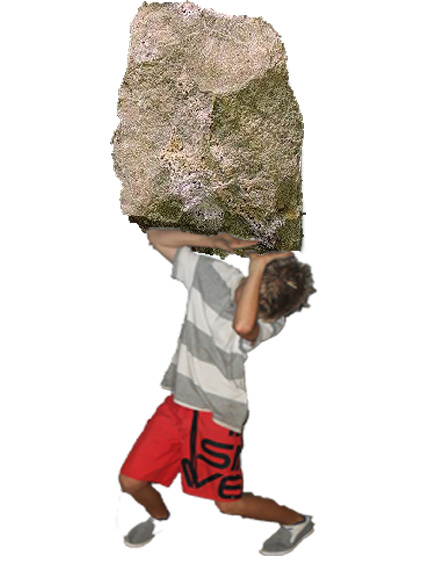
Also, if you see an image with the text, that automatically alters your mindset. If, let’s say, a comic book artist wanted to show someone possessing great strength by lifting a big bolder, he would just draw it. The bare image of someone lifting a rock twice his size over his head is enough for people to get the sense of strength.

You don’t really have that kind of ‘luxury’ in books. The mere act won’t impress your readers, because this great show of strength would be limited to simply one sentence, if you would describe only the action.

“He lifted the bolder over his head.”

We all know that’s a heavy thing to do, but if you only mention it so passé it doesn’t hold strength. Instead, a writer really has to describe what’s going on to get you to see the rock, to feel it’s weight.

“His muscles tensed as his strong hands clutched the rough surface of the rock. He bent his knees, grunting as his biceps budged out from the sheer weight of the bolder, blocking his way. Sweat began to race down his forehead, his chest, his legs, his arms as he slowly lifted the rock off the ground, gasping for air as he did so. And then, just as his body looked like it’s about to give under the weight of the bolder, he victoriously stretched out his arms with a winner’s shout, his heavy burden above his head.”

This way, by describing the act in detail, it becomes much more memorable, and holds much more ‘weight’. This sort of description is necessary to learn if you want to write a really engaging book, and comic books simply have no use of it most of the time.

That is why comics will probably never be the go-to material for aspiring writers, because they simply have no need for certain skills a writer should have. That is not to say that writing/illustrating comics is easy. I’m sure they have their fair share of problem. Keeping balance between text and image must be a hard thing to do for one.


So should we really group comics and literature together? Probably not. The art forms are just too different and surely both would lack if compared to the other’s standards. A much better solution is to just accept comics as art on their own, offering classes focusing on this particular form of art. A collaboration between a literature class and an art class might be a good start, even if it’s very rough.

Saturday, June 14, 2014

Why do we stereotype ourselves?

Recently the number of quiz results notification in my facebook feed taking a sharp rise. Every day I notice some friend of mine has taken another quiz like ‘what kind of color are you’, ‘what mythical creature are you’ and so on and so forth. Some are even really weird like ‘which secret nationality are you’. The latter one actually made me realize how strange these tests are.
In today’s society people are working really hard to deconstruct the social frames and boxes we have built over the years. Race stereotypes, religious stereotypes, gender stereotypes… even hobby-wise stereotypes! It feels like everyone is making an active effort to show that these stereotypes are not who they are .At times we take it to such extremes that people refuse to do a certain thing just because it’s connected to their stereotype. An example would be a woman who loves to cook, but won’t so she doesn’t get stereotyped.


Buuuuuuuuuttttttt….. On the other hand we are completely willing to take these ludicrous tests that put us in completely arbitrary, even broader and more generalized boxes. I just simply started wondering. Why are these tests so appealing? They don’t usually reveal anything about you like a psychological test would. They often consist of very little choices and you can’t put ‘my mythical creature is elf’ on your resume and expect to get into a high-paying position.
I wonder if it could have something to do with the group mentality. We are social by nature and always want to feel connected to other people in some way or another. We like to have the feeling that if we’re like this or like that, we have a group behind us who are also this or that and will support us.

The other reason I could think of is simply being to brag to your friends about it. Like if you’re supposed to be a dragon or something see you find cool or appealing, it can serve as a little confidence boost, even if it’s a silly one.
Plus, these categories don’t affect you like real-world stereotypes would. You won’t get discriminated as an ‘elf’ by your ‘dwarf’ friends (unless you have a very racist role-playing community).  Perhaps it’s better to stereotype with something that’s not harmful, but still lets you feel as part of the group.

I don’t really get it though. Do you take personality quizzes? If yes why? If no… why not?

Monday, June 9, 2014

Why the current Slovene media will NEVER have any impact on the world

At the very start I would like to point out that I am not a person who uses the words ‘never’ or ‘forever’ lightly. I know full well that things change rapidly and life is full of unsuspected surprises. That said, there are little to no arguments that can convince me that Slovenian media will touch anyone other than a few people living in this chicken-shaped country. Moreover, not only do I think it WON’T touch anyone, I think it SHOULDN’T touch anyone.
Perhaps I should explain this very furious argument against my homeland artistic culture. I am not kidding myself that most foreigners, whose country doesn’t directly border Slovenia, probably never heard of it. This is already the first problem. We’re a very tiny ad a relatively new country. Naturally we haven’t been along for very long to earn a lot of street credit and our influence on the world at large has about as much impact on the world as a sneezing ant.
Of course, just general smallness isn’t automatically a rule that says people shouldn’t care about the country’s films or literature, and it does have developed artistic and literary traditions that probably predate America. So why am I so furiously discouraging foreigners from giving a damn?
Well, I don’t want them to think that all Slovenes are BORING AND MONROSE. You see, the before-mentioned traditions are to blame. Around the time realism became the hot new trend in literature, or perhaps even earlier in the enlightenment period, the Slovene people have found a motive that they really liked. Loved actually… Like more than just a friend. 
Basically, they started writing about the simple life of the 18th century Slovene farmers- a novelty at the time.  They described their struggles, the hardships they faced, the traditions they held… These people of course liked it as the stories were relatable and current. This was their life. So the writers stuck with it, and in the latter years they didn’t just fail to unstuck themselves, oh no! They got stuck, nailed and blotted to the concept.
This was only made worse by the fact that Slovene countryside the writers so fondly portrayed in their novels hadn’t gone through any significant changes until socialism started. So what we are left with is always a story about a boy who grew up on a farm, usually with poor finances or just flat out broke. His surroundings were always moody, always angry, always filled with bitterness and sadness. There was always a sick, dying or dead family member and always a struggle to get the boy to school. Stories, or rather just descriptions, of the cities were brief to non-existent and anyone who was better off than the main protagonist was usually a liar, trickster, cheater, hypocrite, uneducated or just generally morally bankrupt.

Granted, this is based on what I’ve learned in school and rare gems of noble-stories or even fantasy might exists. However, THESE are the stories that are being praised, put on a pedestal, seen as classics even. This is what out cultural history was made of for more than 2 centuries. Thus today we hail many different versions of the same story, praising them as something unique because as soon as someone points out they’re nearly identical we’ll see how little progress we made in story-telling and motives.
Considering our cultural past, you can see where the current authors get their style of observing rather than imagining a story. While we have moved past that farm-boy motive and most of today’s books revolving around the life in the modern cities, we still haven’t gotten to a point where we would actually write books with unique new worlds, new character, set in different environments and time periods.

Nope, it’s still the mundane everyman going through his everyday life with everyday occurrences and everyday conversations with everyday people. Except it’s not, because I don’t know any people who are this DEPRESSIVLY boring. There is always some kind of everyday drama, said in the most passive-aggressive manner possible, the characters being too passive to actually solve anything and thus we spin around in circles wondering why these two even bother with one another. They’re not even depressing themselves, just incredibly inactive; reactionary heroes who wait for something to happen rather than make it happen.
This also comes down to an incredible lack in genres. There is no Slovene romance, crime dramas, horror stories or god forbid fantasy. Children books are the most diverse by far, some teeny stories mostly aimed at girls before skipping the young adult section, going straight for adult sections with books about the ‘everyman’ or even stories from the socialistic times. One of these days I will actually research how many of these ‘everyday’ books even mention the Internet.

I sincerely hope the tides will turn soon and more innovative topic will become prolific, but as is, I don’t believe Slovenian movies and books would ever be interesting to the wide, international world.

Thursday, June 5, 2014

Death of a friend: guess not that important!

Death.  Just the simple word holds so much weight. The permanent end, the ultimate stop as far as the average human perception is concerned. It’s upsetting, saddening, tragic… Made worse the closer we are to the one who as passed away.
Death demands attention. So much attention that we even have whole ceremonies centered around the person who might not even be able to appreciate it anymore. It has to be respected, either by standing completely quiet for a few minutes, dressing in black for a month, or in some cases even celebrated with singing. Even if death is made mundane, like during war time, we are still shocked to how not-shocking it becomes.
So, considering this, why are newer authors treating the death of a character’s friend so casually lately?!
It might be a bit early to go out on a rampage, considering this rant is based on only two books I’ve read. Nevertheless, I have to get this off my chest.
I have just finished reading the book The thine. It was written by Holly Black, an author I hold in high regards due to her Curseworkes series. That said, I found this book to be a real let down in a lot of way. Yet, one moment that really got me fired up happened towards the end. Spoiler alert: the childhood friend of the main protagonist dies. Murdered as a result of a chain reaction that the heroine HERSELF set in motion. Not intentionally, but she was involved in it none-the-less.
We can already see there’s a lot of trauma. Not only did she lose pretty much her only friend, but it was because of something she did. The grief, the guilt, the mourning… One would expect this to be a very powerful thing. A whole chapter worth of material if not more. But what ends up happening? The protagonist gets pulled away, they briefly mention she cried herself to sleep after an argument with her boyfriend. Cut to next day where she wakes up and basically TRIES ON OUTFITS. I was starching my head, wondering if I missed a page or ten.  Even the strongest character have some sort of a mood shift is something like a death of a friend happens.
But ok. There was still the thing with the dead friend’s brother still being held captive. The girl was probably going to put the emotions away till they resolve this very urgent matter. Thing is, afterwards there are so many random interactions and the main pair bickering over completely irrelevant relationship problems, that the urgency gets lost. In fact, it makes things look so ordinary that I forgot that her friend just died! And it wasn’t like they had to go through any of it. They knew where the brother was! They should have just went there instead and got him! They didn’t gain any insight or learned any special skills talking to other people.
Then the climax FINALLY happens and the epilog starts. It’s the friend’s funeral. Her brother also just figured out his sister died. It starts out somber enough. And theeeeeeen… the brother offers the girl a bouquet of pixy sticks. ARE YOU KIDDING ME? They don’t talk about his dead sister at all, it’s never shown if the brother asked how she died, or how exactly he was effected by it. Nope. Just pii sticks and off goes the brother so the girl and her boyfriend can have a finishing conversation about kisses with a magical plastic prancing pony. (I am not kidding about the last one)
I was just in shock. I knew the sister might not have been a major character in the story overall, or very interesting for that matter. Yet, it was obvious she must have meant something to the protagonist. We see them interact; we see that they hang out a lot. This should have been a bigger deal! It’s not something you brush off for kisses and pixy sticks.

Thing is, this wasn’t the first time I saw death of a friend handled so insultingly sloppily. A while back I also read another book titled Fallen by Lauren Kate. The first half seemed decent, I guess. Then things started to get weird, then boring or downright silly, but the end was just offensive.
So, just to illustrate my point, I’ll try to summarize real quick. The main protagonist is held in a school for delinquents. She doesn’t make a lot of friends there, but there is one girl that is really nice to her. She’s described as fat and a bit of a loner or maybe even a little geeky, but she’s really nice and helpful. She stays with the protagonist even when things get life-threatening, but in the climax she gets murdered. The protagonist is shocked, but doesn’t really have time at the moment escaping from a crazy killer lay. Afterwards, she gets saved by her hot angel boyfriend and then it feels like: “Friend? What friend? Oh, you mean the fat geek that basically covered my ass the whole story and was killed due to associating with me? Pff, who cares! She was just a human! I wanna party it up with all the angels and I don’t need her weighing me down. I’m off to the tropical islands now, bye-bye!”

I admit that I have forgotten the ending a bit, but I think that she doesn’t even bother staying for the funeral.
So yeah, that makes two books where a dear friend dies and the author treat it like the protagonist’s favorite shirt got ruined. Additionally, it also pulls in the mentality that everything’s fine as long as there is a hot stud to embrace you and tell you that it is not your fault. It’s busy and clustered, downright disrespectful to the deceased! Remember when there were whole revenge plots made because someone got murdered? Wasn’t that long ago I think.

Remember writers; show your characters the same respects you would to a real person.

Tuesday, May 27, 2014

Why literature classes are a joke!

I consider myself a person who does admire and appreciate literature. I enjoy intriguing characters, grappling storylines and immersive writing. If the previous has been supplied, I can even appreciate a particular writing style or stylistic choice so long as it doesn’t make the piece incredibly hard to read. *cough* Ulixes by Joyce *cough* However, I am also a very fickly reader and won’t hesitate to put a book down if I’m not drawn in by it in the first few chapters. I also wouldn’t hesitate to call some old classic out-of-date at best or just word mashes at worst.

Not that my opinion has more grounding than any other, but, going through elementary and high school, I got a feeling the academia flat out fears the fact that I might not perceive any of the ‘classics’ as anything other than God-given gems. They really seemed to do their darnest to make me fall down on my knees and praise some book they declared good. They fragment the text, trying to make us appreciate every little word the author might as well had used on a whim. They focus on the author and all the wonderful things he had done or the perils and hardship he endured as if the book was literally written in his blood. They want us to make personality charts for every single character, regardless of how unimportant they may be. Worst of all, they make us look for profundity that might not even be there.

My point is, we hardly ever discussed these books just as books. We were always spoon-fed our opinion to us, saying these books are great because the academia says they are. We were not allowed to say that we think the convoluted writing alienates the reader, the characters are incredibly passive and uninteresting or the story non-existent. Heaven forbid that you imply that a book from today’s popular culture might do something better! “No!” they would yell, “those books are LEISURE literature! A REAL book must have at least a hundred parallels to an old thing you have never heard of or put style in front of story!”

People who diss these books are seen as uncultured, stupid or too lazy to read something other than basic sentences. Therefore their opinion doesn’t matter and can simply be dismissed. They are never asked why they would prefer the new Harry Potter over Madam Bovary or the new Twilight over Kafka’s Metamorphoses. So there are never new, more daring ideas or concepts brought into the discussion, making the “intellectual” circle polluted with inbreed ideas that had no critics for at least 50 years.
This later carries over into the classroom. Students get bored by having to know every single detail about the author’s life or the book’s release.  We don’t share our actual opinions on the characters or the story, or maybe what we think is good and what’s bad.

The problem is, the academia doesn’t realize this might actually HELP people to appreciate the work, because they would feel their opinion is appreciated as well. For example, for the longest time I considered William Shakespeare’s Romeo and Juliet a terrible love story. They see each other, “fall in love”, get married, die… that’s what the book sounded like to me, a horrible misrepresentation of what true love is like. However, Is tumbled on a video online, also talking about whether or not Romeo and Juliet is bad.  And guess what happened; they showed me a side of the story that I didn’t think about.  That maybe it’s not the story of ‘true love’, but young love. About the time when you actually feel like this love is eternal, without real rational reason. I found that now, I could relate to the story. But in order to get to this point, that someone must have first said that Romeo and Juliet sucks as a ‘true’ love story.

By not discussing literature, but teaching it, we rob the children of a valuable opportunity. If you talk about something where opinions can’t be anything other than subjective, the children would learn how to form their own opinion, present it, respect the opinion of others and learn how to admit they might have been wrong or right on something. It’s an important lesson in tolerance, one that can be done without making them make posters about how bullying is bad or how important acceptance is. Have trust in them, they can work that out on their own if given an opportunity.

The thing is, by the time the kids reach high school, it’ll probably be too late to start. They will be so used to being told what to think that making a discussion group will just confuse them. They will get bored, uninterested. In general, they will have a feeling like what they say doesn’t matter anyway and just carry out the exercise half-heartedly to appease the teacher and not get in trouble.


That is why I believe that the way we teach literature should undergo some fundamental changes, possibly along with the whole educational system. 

Thursday, May 22, 2014

Are schools really anti-boys?

 To be honest I hate being the one who cried 'sexism', but this really got to me. Today, I found this video on the Internet.


My opinion of course won’t hold as much critical value compared to professors and researchers, but I noticed some key factors that disturbed me and made me believe this shouldn’t be taken as seriously as it wants to be.
 1. The whole research is based on stereotypes, right down to the pictures and coloring scheme. It’s all about ‘boys act this way, girls act that way’. They don’t directly say it, but it has an undertone of ALL the boys are disorganized, love sports, don’t like poetry… All of the stereotypical traits we were fighting so hard to combat all these years. The thing is, this is not biological or something that you’re born with. You are raised to be this way, either directly by your parents pushing you into sports or arts, or passively over social norms that are in their nature arbitrary.
2.   It mixes issues.
The extreme cases listed, like the example with the pirate drawing or the cookie gun, are not schools being against boys. It’s an issue with violence, or more clearly, gun control. America, as far as I know from the media, is extremely reluctant to enforce even the slightest bit of gun control. That’s why terrified schools, wanting to avoid mass shootings, enforce the ‘zero tolerance’ policies. The theory is that if they punish kids for bringing up gun-related images, they won’t develop the desire to do so. This theory has more holes than Swiss cheese, but that’s a topic for a whole other discussion. The point is that this then affects the boys more than it does the girls because guns were seen as traditionally boy toys, so it naturally there will be more incidences with boys than with girls. You’d get the exact same result if schools decided to ban extra skinny dolls from school in fear of spreading negative self-image. You’d expect more girls to be affected by this than boys.

3.  It never addresses what actually happens after they graduate.
Maybe this is a bit unfair as it is not directly relevant to the topic, but I really think it should be covered. They say that boys do much worse in school than girls, but it never says that regardless of that, they will still get higher pay and higher-ranking jobs as women. It never mentions that most departments are run by men.
4. General flaws masked as specifically male-targeting
What this video does raise are some good critics on the overall education system. Children are not given enough free time, enough moving space, there isn’t enough diversity or choice within the system, etc. however, they present them as specifically anti-male, even though they have largely remained unchanged for centuries. Teaching and focusing on fictional literature and poetry is not a new thing. People studied it for centuries and there was just no one to call it out on it. There was no one in the 19th century going: “I don’t think poetry is suitable for men and thus we should write about swordfights!” I’m not saying we shouldn’t include more action-oriented literature in our school program, but it’s not a recent thing designed to make life harder for boys.
 
Lastly, I would like to offer my modest, unprofessional opinion on why the current school system is becoming ‘anti-boys’. You see, the motto of the school system is for the most part ‘obey’.  Even after all the reforms, it’s still designed for younger, less educated individuals to obey the authority-figure of the teacher. This is basically the environment for the old female archetype- obey the author of your husband, parents, social construct… While it was typical for men to be thought to BE the authority. Meaning there is a natural clash. In the past, the upbringing and education system was stricter, able to break the authoritarian needs. Now, the screws are loosened for the sake of a friendlier environment, but this allowing the children to also misbehave. What would also be an interesting study is to survey if children misbehave more if taught by a male or a female teacher, or if gender matters at all.


This, as I said, is completely a wild guess and probably just as based on old stereotypes as the before mentioned video, but it hopefully gives some food for thoughts and maybe opens a discussion. 

Saturday, May 3, 2014

My concerns for the upcoming Sims 4


Ever since EA announced the Sims 4 about a year ago I have been having trouble figuring out whether I’m excited or severely disappointed. I have been a pretty big fan of the franchise ever since The Sims. My love for it only grew when the Sims 2 came out, but ever since they’ve put out Sims 3 I had the feeling it’s slipping more than just a bit.
Now I have a lot more concerns about the continuation of the game as it has been announce there will be a shift in the animation style. While the previous Sims games tried for greater realism in their games, The Sims 4 wants to move towards stylized realism.
On the one hand, I get why someone might want to do that. If you stylize, you can skip rendering some of the details and so make it easier to run on the computer. This must be especially important now that the sims are supposed to emote more than in the previous games. The other reason might also be to avoid the uncanny valley effect.
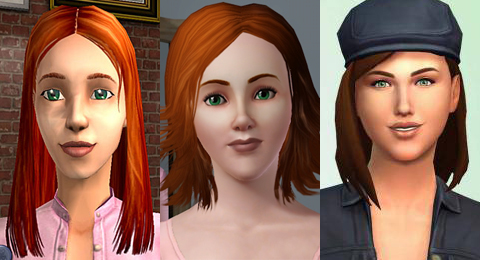
While that is all fine and good, I do not like the current style at all. It has a very plastic feel to it. This shows especially in the hair. It looks like a plastic wig someone put one a playmobil doll. I am not saying they should animate every single hair on one’s head. I think making ends a bit more tattered would go a long way. Sims 2 understood this and it had worse graphics. The same goes for the eyelashes. I am still wondering if the hair animation will be better, but I doubt considering that the Sims 3 hair animation looked like everyone did their hair with a nearly lethal amount of hairspray.


In addition, I think the style change puts the sims more into the uncanny valley than before. There is no reason to worry about people having hang-ups controlling the programmed version of big brother guys! That’s what they’re here for. Know your audience! That’s like a shooter going: “Hmm… maybe we should replace the guns with water pistols. Don’t want the game being too violent.”

The other thing that really worries me is the current trend EA has put in the Sims 3 already. Ever since The Sims 2 there has been an ever greater lack in content. The expansion packs did at least introduce new things to do, but the stuff packs are now nearly insultingly empty.
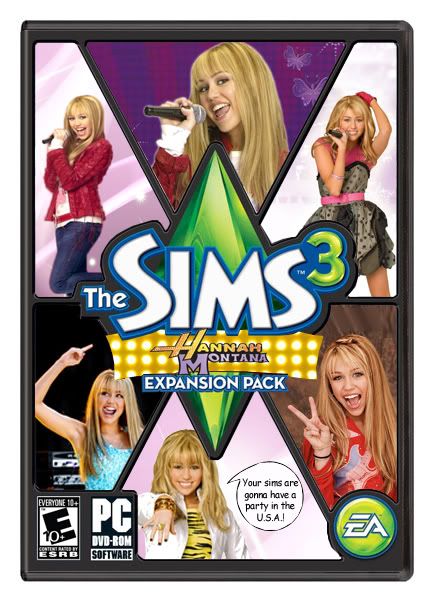
I would also like to see them not trying to cram currently ‘hot’ things into expansion pack like they did with that Katy Perry and Diesel, it just dates the game. Why not just label the expansions ‘Candy land’ and ‘An empty box’? (ba dum tssss)

(Now wouldn't this be horrible?)

Lastly, please…Please, for the love of whoever you worship, add more variety this time! The outfits and hairstyles in Sims 2 were a lot more varied in the core game alone. The only game where I felt they included something other than a few token ‘different’ things was in the Supernatural and World adventures expansion pack.

Well, that’s about all that’s on my mind right now. I am still psyched to see the new emotion-based gameplay and the retouched building system, but I hope it’s not a let-down like Sims 3 was.

So what do you think about the new style-love it or hate it?What things would you also like to see them add/remove?

Thursday, March 13, 2014

American Purity balls

I leaned about this today and quite frankly I was outraged. I know there is almost no way I can’t make this post controversial  and considering I never stepped foot in America I might not be the best to judge, but I really want to express this and I’ll try to explain why.
So, today I found out about a new American trend called Purity balls. From what I’ve seen, it’s about girls as young as 5 attending these ceremonies with their families, but most importantly, their fathers. It’s a fancy formal ceremony where they wear pretty dresses and tiaras and have what I imagine is a pretty gourmand meal. However, the girls take a pledge to God and their fathers, swearing to keep their virginity until marriage. Afterwards, the have a father-daughter dance.  If you want to see the dances for yourself, here are a two Youtube links to get you started: http://www.youtube.com/watch?v=z_KL92oBWcQ

First of all, I have a serious problem with teaching young people only abstinence in the first place. It’s not so much a problem as a girl deciding she is uncomfortable having sex unless the context of a marriage. For me, it becomes a problem when someone thinks it is his or her place to make that decision for her. I would be equally appalled by a parent forcing his child to have sex as I would be by a parent strictly forbidding it. A job of a parent is to educate and warn their child about the world, telling them what consequences their actions may have and presenting them truthfully, not making their decisions for them. Especially not regarding something as personal as sex.

Secondly, it digs into the realms of peer pressure. It is a thing that is essentially unavoidable, but making such a personal choice public like that does not help it one bit. It puts the girls in a position where they have to loudly declare their position in front of everyone. It may not seem like it, but it is. What if a girl says she does not want to take the pledge? It may not necessarily be because she has or is planning on having sex; she simply does not know where she stands on the topic yet, and really, if you’re below about 15 you are still getting to know your body. Worst of all, people take their five-year-olds to these balls. FIVE! At that young age your body hasn’t even BEGAN to mature. These girls have no idea what they’re saying; they are only taking the pledge because they can wear pretty dresses! They still have no idea what sex is about and yet you are already making them say no to it?

Thirdly, the ‘Princess Myth’ has never been more apparent. The ‘Princess Myth’ is where girls are led to believe that if they will be patient, pure and obedient, their prince Charming will come and sweep them off their feet. It essentially is the foundation for the stereotypical house wife who will rely on the man to bring in the money. Yet the truth is that life doesn’t always work that way. I won’t even touch on the chances that that ‘Prince Charming’ may become abusive, but what if he dies? What if he finds another? What if he has an accident and is unable to work? Why if the economy is so bad one wage will not be enough to feed the household? These are all horrible, but important things you need to consider and all speak against one spouse relying on the other.


Lastly, they play this as father-daughter bonding, but really it looks like they try to push the father into the role of the boyfriend, or rather your husband. The girls promise their chastity to them, like a woman promises she will be fateful to her husband, and not only that. She essentially promises her chastity to her dad, to God, to Jesus, but never to herself. This is what really worries me.

Wednesday, March 12, 2014

Blogging commands

After reviewing a few blogs from last semester, I came up with a few ways I might improve mine by following these commands:
1. Thou shall blog often!
This one should be pretty obvious. A blog is much more interesting to follow if there is new content every week as opposed to one per month and then a whole storm of them at the end. Perhaps picking a day when you absolutely have to blog. Think of it as a little ritual to honor the gods of the pen and keyboard.  Just get advised by the International God Council first. The amount of vacant days of worship is running pretty scarce.


2.  Thou shall incorporate pictures!
They say a picture is worth a thousand words so there is no better way to kick up the word-count on your 300-wordy blog entry. However, it also makes the blog more inviting. If you were inviting someone to a party you would rather choose an invitation with a cute picture and a witty line instead of smashing them over the head with a block of text. So always make sure you add an appealing, theme-appropriate picture for about every 100 words.


3. Thou shall write about what you like!
Why bother researching trade routes during the First World War if you fall asleep just reading the first passage? If you are bored by the topic, chances are your readers will be as well. So why not write about something you already know, or would like to know, and are passionate about? Even if you just dedicate a whole blog entry about watching grass grow it might still be entertaining to read if you’re passionate about it. Yet, you might want to try and make the title more appealing, like: “The adventures in the green!”


So, these are my little commands for myself and anyone else who finds them helpful. Learn them, know them, live them and pray five Guardian Erasers if you break them.

Saturday, January 11, 2014

Star wars, the money wars...


As I mentioned in my post about Tera, I am not a fan of Star wars: the old republic ideas of free gaming. So I thought I made a post dedicated only to that game and include any additional things that spiked my rage and the things I actually liked.
I should also point out that it has been a while since I’ve played the game, so it is very likely that things have changed or have been updated. I am not well-versed in the Star wars universe either, so don’t expect me to judge any story flaws and such.  

The good things

Well, I can’t really say it was all bad since the game had me glued to my screen for longer that I care to admit now. Some aspects were really interesting and did make you want to play more.
The first of one was the way the story was told. I have to admit, there must have been quite a budget behind this one. Basically anytime you talk to someone you’ll get a full animated scene of the characters talking… and you can actually talk back! You are given choices (2-3) of how to reply, some replies making you good and the others evil. You can even choose if you would rather bribe a certain snitch, kill him or get his silence by flirting. That’s how my character accidently had a very… private encounter with a particular “horny” Zabrak. (If you got that joke you most likely don’t need this review.)
The other thing that stuck with me was getting your very own spaceship. That did allow for a very interesting fast travel system from one planet to another. It also gave you the opportunity to engage in space battles and mission with your ship, giving the game a more varied way of fighting. You could even make your own crew and best of all; you could even take one member as your companion that aided you in fights.
Now on a more feminist note, I have to applaud the game for their portrayal of women. The female characters were no less clothed than men, wearing the same spy suit and the same jedi robes. That is one of its key points against Tera, where the girls still seem to miss key parts of their armor. Also, the female characters of SWTOR you interact with are all just as fleshed out as men. It really is a big step in the right direction of female portrayal in video games, at least in my opinion.

The bad things

For starters, I’d cross the “free to play” sign right off it. It felt like at every turn the game was grabbing for my wallet and urging me to pay for something. I fully acknowledge that games also need to earn money for maintaining their servers and so on, but when you restrict the gameplay like this, I wonder why you would even bother making the game free. At the very start, a lot of playable races are locked down and can only be obtained by becoming a paying member. Alright, I can live with playing as a cyborg and not a miraluka. However, then the game starts taking away more and more. Some useful skills like sprint or mount are pushed back several levels, making going from point A to point B incredibly tedious. There is equipment that monsters drop, but you yourself are not allowed to equip without paying real money first and even the basic feature like trading object with or sending letters fellow players is taken away. That was the striking point for me.
The other one is its combat. I don’t remember anything special about it. It was the tried and tested ‘click on enemy’ system that most MMO games use. It was alright back then, but after experiencing Tera’s combat I got spoiled. Another thing was that the enemies were usually grouped together. It wasn’t that bad since most of the objectives wanted you to kill off a massive amount of them, but the problem was you, the player, had no real means to avoid taking damage. The most you could do is build up your defense, get better armor and hit the dodge button every now and then. The fights usually left you with low health, making you either spend a fortune on med packs or making you wait for a long time between each fight to replenish your health.


Missed opportunities

Let’s move on. Remember those choices I talked about. Yeah, as the game progresses, that incredibly interesting feature slowly amounts to nothing. While it does make you follow the story a lot more than most other MMO games, the choices you make don’t seem to affect much. Your reactions are mostly forgotten. When it does matter for you picking the light or dark side, you even have little icons to tell you what’s good and what’s bad! It stops being about finding out which option is right or wrong, but a decision of: “Do I want my eyes to be red or white?” Yeah, the riveting moral grayness does not exist in this game, as you can see. Which is a shame as it would make the game so much more interesting to play. However, all you get is obvious, clear defined choices that are mostly about either killing a person for a bigger reward, or letting them go.

Conclusion

Star wars was a fun game to play for the time being, but now remains an unvisited icon in my game folder. All the buyable features along with the draggy combat and black-white decision-making really stared to get on my nerves. It is not a title I would recommend as it was back in the days of my brave jedi/sniper expeditions.