In the
video about Anti-boy schools I noticed that the woman mentioned we should
employ comic books as reading material in schools. I thought about the idea in
an extension to just employing comics in literature studies all together, use
it for references for aspiring writer. However, despite some of the comics
being masterfully written with intriguing stories, complex characters, and
really good writing, there is a fundamental difference between books and comic book
that simply disables using comic books as literature reference.
 Does that
mean I think comic books shouldn’t be regarded as a form of art? Of course not.
I’m completely aware of comics being able to carry just as much drama and depth
as books or any other media for that matter. I mean, it’s basically take two
forms of art, writing and drawing, and puts them together. How can that NOT be
considered art? While superhero comics are the ones most popular, they can also
tackle sensitive or everyday material. If you are not sold on how good comics
can be, I recommend reading the online comic Sunstone by Stjepan Šejič here. That
is, if you are over 18.
Does that
mean I think comic books shouldn’t be regarded as a form of art? Of course not.
I’m completely aware of comics being able to carry just as much drama and depth
as books or any other media for that matter. I mean, it’s basically take two
forms of art, writing and drawing, and puts them together. How can that NOT be
considered art? While superhero comics are the ones most popular, they can also
tackle sensitive or everyday material. If you are not sold on how good comics
can be, I recommend reading the online comic Sunstone by Stjepan Šejič here. That
is, if you are over 18.
So why can’t
we employ them for literature studies? It has a large part to do with the fact
that comics are illustrated, employing a visual aid in a way.
When
writing a book, a writer must rely on words, and words alone. He can’t show you
what a grassy plain looks like, or a great mountain. He is reliant only on the
black ink on the paper and your imagination. For that, he has to learn to choose
every word he uses carefully, knowing the slight difference in how that
particular word will affect its readers, what they will imagine.

Comic books
don’t have that problem. They CAN and they WILL show you what that grassy plain
looks like. They can even portray a lot of emotions just by drawing. Additional
words of description will just seem redundant and take the reader out of the
story. Yet, that means that almost all sort of description get pushed back,
emotional writing limited to dialogues.
Also, if
you see an image with the text, that automatically alters your mindset. If, let’s
say, a comic book artist wanted to show someone possessing great strength by lifting
a big bolder, he would just draw it. The bare image of someone lifting a rock
twice his size over his head is enough for people to get the sense of strength.
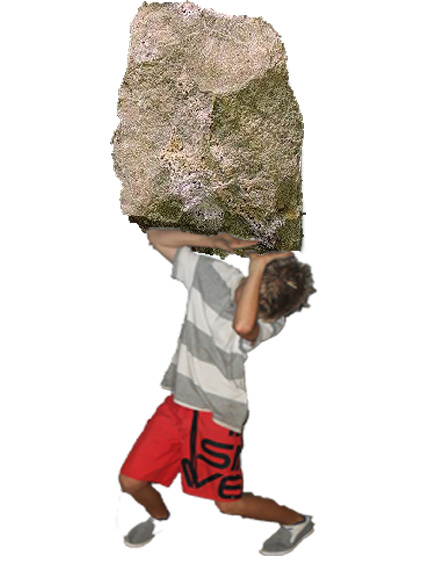
You don’t
really have that kind of ‘luxury’ in books. The mere act won’t impress your readers,
because this great show of strength would be limited to simply one sentence, if
you would describe only the action.
“He lifted
the bolder over his head.”
We all know
that’s a heavy thing to do, but if you only mention it so passé it doesn’t hold
strength. Instead, a writer really has to describe what’s going on to get you
to see the rock, to feel it’s weight.
“His
muscles tensed as his strong hands clutched the rough surface of the rock. He
bent his knees, grunting as his biceps budged out from the sheer weight of the
bolder, blocking his way. Sweat began to race down his forehead, his chest, his
legs, his arms as he slowly lifted the rock off the ground, gasping for air as
he did so. And then, just as his body looked like it’s about to give under the
weight of the bolder, he victoriously stretched out his arms with a winner’s shout,
his heavy burden above his head.”
This way,
by describing the act in detail, it becomes much more memorable, and holds much
more ‘weight’. This sort of description is necessary to learn if you want to
write a really engaging book, and comic books simply have no use of it most of
the time.
That is why
comics will probably never be the go-to material for aspiring writers, because
they simply have no need for certain skills a writer should have. That is not
to say that writing/illustrating comics is easy. I’m sure they have their fair
share of problem. Keeping balance between text and image must be a hard thing
to do for one.
So should
we really group comics and literature together? Probably not. The art forms are
just too different and surely both would lack if compared to the other’s standards.
A much better solution is to just accept comics as art on their own, offering
classes focusing on this particular form of art. A collaboration between a
literature class and an art class might be a good start, even if it’s very
rough.
